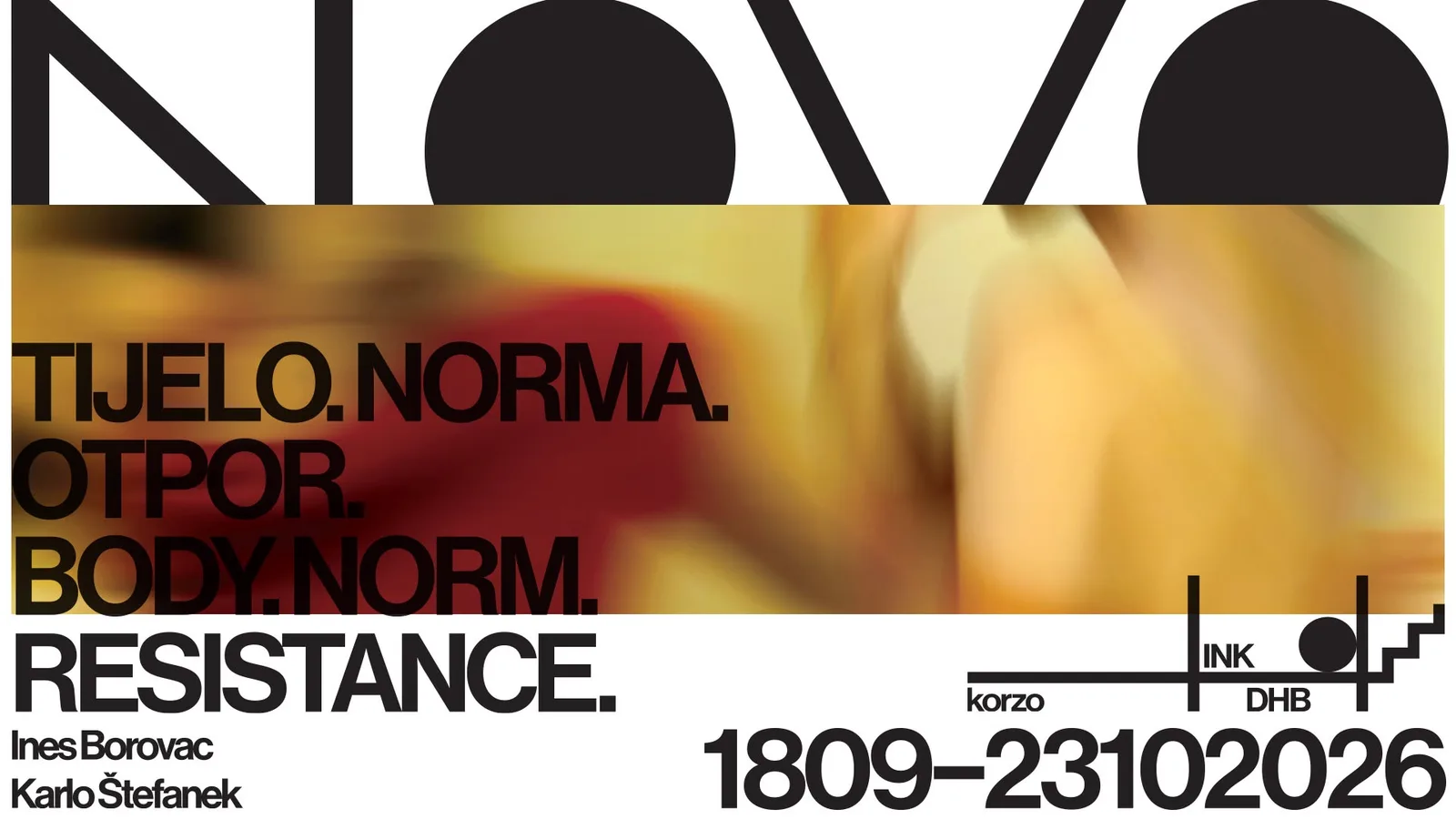
BODY. NORM. RESISTANCE. – Ines Borovac and Karlo Štefanek
Date
18. September – 23. October 2026
18:00 – 18:00
Location
Pula
BODY. NORM. RESISTANCE. Ines Borovac and Karlo Štefanek 18.9.2026 at 8:00 PM Exhibition opening Gallery Novo, Association Proces, and Association Metamedia invite you to the opening of the exhibition "BODY. NORM. RESISTANCE." by Ines Borovac and Karl Štefanek, taking place on Friday, September 18, 2026, at 8:00 PM. The exhibition explores how social norms shape, interpret, and direct the body. Working across various media, the artists reflect on gender, identity, belonging, desirability, and societal expectations, as well as the possibilities for shifting these boundaries and resisting them. As part of the exhibition, Karlo Štefanek will deliver a performance that expands this investigation of the body and its social roles into live performance and direct engagement with the audience. The exhibition is curated by Sabina Oroshi and organized by the Proces and Metamedia associations. *** Before it speaks, the body has already been read. Gendered. Dressed. Made desirable. Classified. Nationalized. Sexualized. Remembered. Corrected. Photographed. Financed, or not. Given permission, or denied it. The body enters the world surrounded by instructions. It moves almost constantly within a field of interpretation. Repeated expectations tied to gender, desirability, social acceptance, nationality, or class gradually become inscribed into habits of self-presentation. The body learns how much space it is allowed to occupy, which gestures are considered appropriate, what makes it legible, and when expression becomes excessive. It also learns to anticipate the other person's gaze before that gaze reaches it. Social interpretation, over time, enters into the way the body inhabits itself. The works of Ines Borovac and Karlo Štefanek inhabit this unstable space between what the body has inherited and what it can still do with that inheritance. Their practices proceed from already existing languages through which the body is recognized, evaluated, and classified. The norm persists because it is repeated, and within that repetition the possibility of shifting it opens up. A familiar gesture can be minimally altered. A role can be taken on in a way that disrupts the distribution of authority. A symbol can remain visible and yet lose the certainty of the meaning it is supposed to secure. For Borovac and Štefanek, closeness to structure is important for understanding resistance. bell hooks understands the margin as a position produced by structures of domination, but also as a place from which a different way of seeing can emerge. As she writes, standing at the margin allowed one to look both from outside toward the center and from inside outward, attending to both the center and the margin and coming to understand each of them (hooks 1989: 20). To be at the margin, for hooks, means to know the center without fully belonging to it. Such a position carries the consequences of exclusion, but it also produces knowledge of the center's rules: how they operate, what they protect, and where they become vulnerable to disruption. Resistance can therefore arise out of a very close familiarity with the structure it calls into question. The question of the norm, however, does not end with the bodies depicted in the artworks. Behind the visible work stands the body of the artist, who travels, negotiates, waits, adapts, and depends on the material conditions of realization. When a work enters the gallery, it also enters a system of decisions about space, time, permissions, and resources. The institution therefore participates in the production of norms just as concretely as the social codes that the artwork seeks to make visible. Cultural institutions have become remarkably adept at the language of resistance. Feminism, queerness, and disagreement circulate through exhibitions and public programs. Resistance has acquired institutional visibility; it enters as a program that can be photographed, promoted, and archived. An institution such as the one hosting this exhibition can embrace the image of a disobedient body, while expecting from the artist who produces it administrative compliance, economic flexibility, and endless adaptability. Radicalism is easier to sustain at the level of representation than as a condition of production. In the exhibited works, norms become visible through the ways bodies are shaped, named, classified, observed, and disciplined, while resistance appears in the moments when these processes are disrupted. Less visible are the conditions under which these works are created and arrive at the gallery space. The final installation excludes the negotiations, production labor, available resources, permissions, and support on which its realization depended. When these conditions, too, are taken into account, the question of norms extends to the institutional framework within which the work becomes possible. What conditions does the institution create for the artist who takes on risk? Who bears the consequences when support, time, or infrastructure are lacking? How much space does the institution truly leave for experimentation and uncertainty? And what does institutional care even mean if the burden of sustaining it keeps falling back on artists and cultural workers? (Sabina Oroshi) *** The exhibition remains open until October 23, 2026, and can be visited during gallery working hours or by prior appointment: SEPTEMBER Monday – Wednesday: 10:00 AM – 2:00 PM Thursday – Friday: 6:00 PM – 9:00 PM OCTOBER Monday – Wednesday: 10:00 AM – 2:00 PM Thursday – Friday: 5:00 PM – 8:00 PM